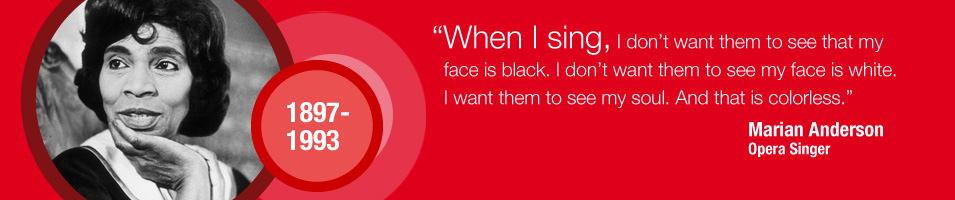
Marian Anderson
Marian Anderson, born in Philadelphia, Pennsylvania, was an American
contralto. Anderson joined a junior church choir at the age of six
and applied to an all-white music school after her graduation from
high school in 1921 but was turned away because she was black. She
continued her singing studies with a private teacher and debuted
with the New York Philharmonic on August 26, 1925, scoring immediate
success, on stage and with the critics.
In 1928, she sang for the first time at Carnegie Hall. Her reputation
was further advanced by her tour through Europe in the early 1930s
where she did not encounter the racial prejudices she had experienced
in America. Anderson’s most famous concert, held on Easter Sunday
in 1939 on the steps of the Lincoln Memorial, attracted a crowd
of more 75,000 of all colors and was a sensation with a national
radio audience of millions. Anderson symbolized the civil rights
movement with dignity and grace; she was the first African American
to be named a permanent member of Metropolitan Opera Company and
was a frequent performer at the White House. During World War II
and the Korean War, Marian Anderson participated by entertaining
the troops in hospitals and bases. By 1956, she had performed over
one thousand times.